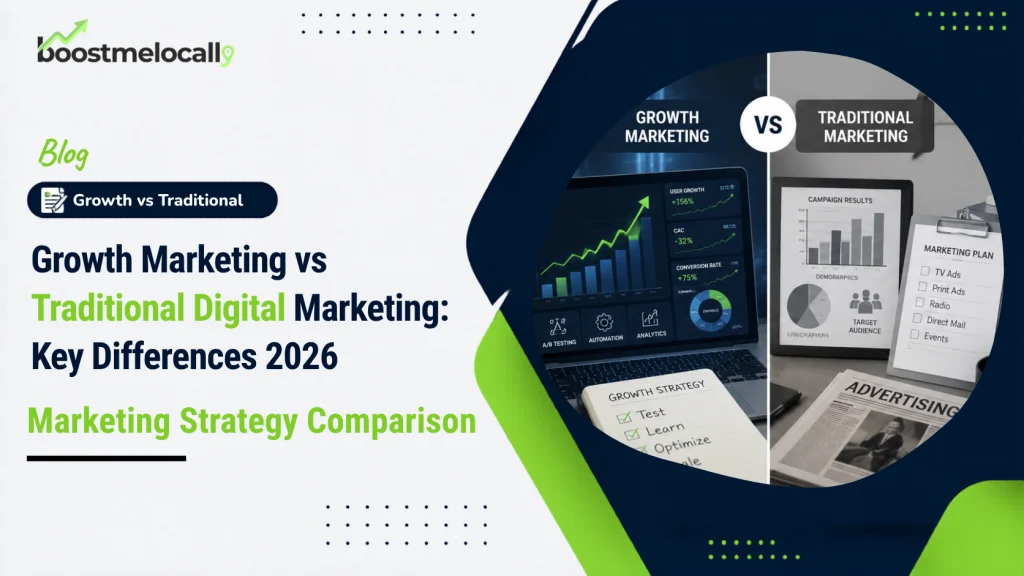
Growth Marketing vs. Traditional Digital Marketing: What Every Business Owner Needs to Know in 2026
Growth Marketing vs. Traditional Digital Marketing
Introduction: Every business running paid ads, publishing blog content, or posting on social media is doing some form of digital marketing. But in 2026, doing digital marketing and growing from it are two very different things — and the gap between them is costing businesses more than they realize.
Global digital ad spend has reached $740 billion in 2026, yet the majority of marketing leaders still cannot connect their spend to actual revenue. The problem isn’t the budget. It’s a strategy.
Traditional digital marketing was built for an era when getting attention was the hard part. Today, attention is abundant — converting it into customers, revenue, and long-term loyalty is where most businesses fall short. Growth marketing was built specifically to close that gap, treating the entire customer lifecycle as a marketing responsibility.
This guide breaks down 10 critical differences, which model fits your business stage, and where to invest for compounding, sustainable growth.
Why This Comparison Matters in 2026
Most businesses in 2026 are spending more on marketing than ever — and getting less clarity on what’s actually working.
Here’s the uncomfortable reality:
- Only 36% of marketers say they can accurately measure ROI
- 47% struggle to measure ROI across multiple channels due to attribution complexity
- 25% of marketing budgets are wasted on efforts that fail to drive outcomes — rising to 30% for organizations with frequently misleading metrics
- Two-thirds of marketing leaders say their dashboards show success that fails to translate into actual revenue
This is what researchers call the Marketing Data Mirage — campaigns that look healthy on the surface, but don’t connect to business growth at the bottom line.
The reason so many businesses are caught in this trap comes down to one thing: they’re using a traditional digital marketing mindset in an era that demands a growth marketing approach.
Understanding the difference between these two isn’t an academic exercise. It’s the most important strategic decision a business owner, CMO, or marketing lead can make in 2026.
What Is Traditional Digital Marketing?
Traditional digital marketing refers to the established playbook most agencies and in-house teams have been running for the past decade. It’s campaign-based, channel-focused, and typically measured by reach, impressions, click-through rates, and traffic.
The traditional digital marketing approach operates in familiar channels:
- Search Engine Optimization (SEO) — ranking for keywords to drive organic traffic
- Pay-Per-Click (PPC) Advertising — Google Ads, Meta Ads for paid traffic
- Social Media Marketing — posting and promoting across platforms
- Email Marketing — sending broadcast campaigns to subscriber lists
- Content Marketing — producing blogs, videos, and infographics for awareness
- Display Advertising — banner ads across publisher networks
The traditional model works like this:
Plan a campaign → Execute the campaign → Report on reach and traffic → Plan the next campaign.
The focus is predominantly on the top of the funnel — driving awareness and getting people to click. What happens after the click, and how those visitors become paying, loyal customers, is often left to chance or to another team entirely.
Traditional digital marketing was built for an era when getting in front of people was the hard part. Today, attention is abundant and cheap — but converting attention into revenue is the real challenge.
What Is Growth Marketing?
Growth marketing is a data-driven, experiment-led discipline that treats the entire customer lifecycle as a marketing responsibility — from first awareness to long-term loyalty and referrals.
Growth marketing was born out of the startup world’s need to grow fast with limited budgets. It blends marketing science with product thinking, behavioral psychology, and revenue operations. Rather than running campaigns, growth marketers build systems — feedback loops of testing, learning, and scaling what works.
The growth marketing model works like this:
Form a hypothesis → Run an experiment → Measure the result → Kill what doesn’t work → Scale what does → Repeat.
The result is a compounding revenue machine that gets more efficient over time, rather than a treadmill of campaigns that stop the moment the budget does.
The Core Philosophy Difference
This is the clearest way to understand the fundamental divide:
| Traditional Digital Marketing | Growth Marketing | |
| Primary Question | “How do we reach more people?” | “How do we turn attention into revenue?” |
| Core Belief | Marketing’s job is to generate traffic | Marketing’s job is to drive business outcomes |
| Operating Rhythm | Quarterly campaigns | Continuous experimentation |
| Success Measure | Reach, impressions, traffic | Revenue, retention, LTV |
| Relationship to Data | Report on what happened | Act on what’s happening |
| Relationship to Failure | Avoid it | Learn from it quickly |
| Team Mental Model | Creative agency | Scientific lab |
The most important insight here: traditional digital marketing stops at the click. Growth marketing starts there.
Head-to-Head: 10 Key Differences
1. Funnel Coverage
Traditional Digital Marketing: Primarily top-of-funnel (awareness and traffic generation). Most campaigns are designed to get people to a website or landing page. What happens next is rarely the marketer’s problem.
Growth Marketing: Full-funnel ownership. Growth marketers are responsible for every stage — Awareness, Acquisition, Activation, Revenue, Retention, and Referral (the AAARRR framework). The funnel is not a handoff — it’s a continuous loop.
Why it matters: The biggest revenue leaks in most businesses happen between acquisition and retention — exactly where traditional marketing stops paying attention.
2. Approach to Data
Traditional Digital Marketing: Retrospective. Data is collected, compiled into reports, and reviewed at the end of a campaign to judge whether targets were hit. Decisions are primarily qualitative or based on industry best practices.
Growth Marketing: Real-time and predictive. Companies that adopt comprehensive marketing attribution models report 37% higher marketing ROI, and those leveraging real-time analytics enjoy 34% faster decision-making and 28% better campaign performance.
Why it matters: In a fast-moving market, monthly reporting cycles mean you’re always optimizing for last month’s conditions — not today’s.
3. Testing Culture
Traditional Digital Marketing: Limited testing. A campaign is planned, approved, launched, and run. Creative variations might be tested occasionally, but systematic experimentation is not standard practice.
Growth Marketing: Experimentation is the core operating model. Every headline, CTA, landing page, email subject line, and onboarding flow is treated as a hypothesis to be proven or disproven. A/B testing is not a feature — it’s a reflex.
Proof point: Automated emails triggered by specific customer behaviors outperform traditional scheduled campaigns by 2,361% in conversion rates. That gap exists precisely because growth marketing treats every touch point as testable.
4. Success Metrics
Traditional Digital Marketing:
- Impressions and reach
- Website traffic and page views
- Social media followers and engagement rate
- Click-through rate (CTR)
- Cost per click (CPC)
Growth Marketing:
- Customer Acquisition Cost (CAC)
- Customer Lifetime Value (LTV)
- LTV:CAC Ratio (target: 3:1 or higher)
- Monthly Recurring Revenue (MRR)
- Churn rate and retention rate
- Net Promoter Score (NPS)
- Activation rate and time-to-value
- Revenue attribution by channel
The difference is stark: one set of metrics tells you how many people showed up. The other tells you how much money you made and whether you’ll keep it.
5. Campaign Lifespan
Traditional Digital Marketing: Campaign-based. A campaign has a start date, an end date, and a budget. When it ends, results are reviewed and the next campaign is planned. Growth stops when the campaign stops.
Growth Marketing: System-based. The goal is to build self-reinforcing systems — content that compounds, email sequences that run indefinitely, referral programs that generate customers 24/7. The work done today pays dividends for months and years.
The compounding effect: SEO content written today may generate leads for the next 3–5 years. A referral program built this quarter can reduce your blended CAC indefinitely. Traditional campaigns, by contrast, generate zero return once the budget is spent.
6. Relationship with Retention
Traditional Digital Marketing: Retention is someone else’s job — usually customer success, support, or account management. Once a customer is acquired, marketing declares victory and moves on to the next acquisition target.
Growth Marketing: Retention is a primary marketing lever, not an afterthought. The numbers justify this completely:
- A 5% improvement in customer retention can boost profits by 25–95%
- Retention-focused companies grow 2.5x faster than acquisition-focused ones
- It costs 5–25x more to acquire a new customer than to retain an existing one
- Existing customers have a 60–70% probability of converting on a new offer vs. 5–20% for new prospects
The traditional model ignores the single most powerful profit lever available to any business.
7. Channel Strategy
Traditional Digital Marketing: Channels are typically siloed. The SEO team manages organic. The paid team manages PPC. Social has its own strategy. Each channel reports its own metrics, and there’s often minimal coordination between them.
Growth Marketing: Channels are integrated into a unified acquisition and retention system. The paid strategy feeds learnings to the organic strategy. Social remarketing amplifies email sequences. SEO content supports paid landing pages. Data flows across the entire stack.
The problem with silos: Organizations with 11–25 marketing tools report unclear ROI in nearly 90% of cases — compared to 62% for those with 6–10 well-integrated tools. More channels without integration = more noise, not more signal.
8. Content Strategy
Traditional Digital Marketing: Content is primarily for brand awareness — blogs that rank, social posts that engage, videos that get views. Success is measured in traffic and shares.
Growth Marketing: Content is mapped to revenue outcomes. Every piece of content is designed for a specific intent (informational, commercial, transactional) and a specific stage of the funnel. Content is tested, iterated, and connected to conversion metrics.
2026 benchmark: Companies with advanced content marketing programs see a 133% increase in revenue compared to those without. That ROI doesn’t come from traffic alone — it comes from mapping content to the buyer journey and measuring all the way to revenue.
9. Personalization
Traditional Digital Marketing: Broad-audience messaging. One ad runs to many people. One email goes to the whole list. Personalization, if it exists, is superficial — like including a first name in an email subject line.
Growth Marketing: Deep behavioral personalization. Growth marketers segment audiences by behavior, intent, stage in the funnel, industry, and past interactions — then deliver messaging that feels individually relevant.
- 71% of consumers expect personalized interactions — and 76% feel frustrated when brands miss the mark
- Personalization can boost marketing revenue by 10% or more
- 47–76% of consumers say they expect brands to understand and adapt to their needs
10. Relationship with Customer Lifetime Value
Traditional Digital Marketing: LTV is a finance metric, not a marketing metric. The marketer’s job ends at conversion.
Growth Marketing: LTV is the north star metric that everything else is built around. When you know your LTV, you know exactly how much you can afford to spend on acquisition (CAC), which channels are truly profitable, and where to invest in retention to maximize revenue per customer.
The LTV:CAC benchmark: A healthy business maintains a 3:1 LTV:CAC ratio — meaning for every $1 spent acquiring a customer, you generate $3 in lifetime value. Businesses below this ratio are bleeding revenue; those above it have a scalable growth engine.
How Each Approach Measures Success
Here’s a concrete example of how the two approaches report differently on the same campaign:
Scenario: A business runs a 3-month content + paid campaign targeting SMB owners.
| Metric | Traditional Report | Growth Marketing Report |
| Impressions | 2.4 million ✅ | — |
| Website Traffic | +38% ✅ | — |
| Social Engagement | 12,400 interactions ✅ | — |
| New Leads Generated | — | 847 leads |
| Lead-to-Customer Rate | — | 6.8% |
| New Customers | — | 57 |
| Average LTV | — | $3,200 |
| Revenue Generated | — | $182,400 |
| CAC | — | $214 |
| LTV:CAC Ratio | — | 15:1 ✅✅ |
| Estimated 12-Month Organic Value | — | $41,000 (compounding SEO) |
The traditional report looks excellent. The growth marketing report tells you what it was actually worth.
Budget & ROI: Where the Money Actually Goes
One of the most important practical differences is how budgets are allocated and how returns are measured.
Traditional Digital Marketing Budgeting
Budgets are typically allocated by channel (e.g., 40% PPC, 30% social, 20% content, 10% email) based on last year’s plan, industry benchmarks, or gut instinct. The budget is fixed at the start of the quarter and rarely adjusted mid-flight based on performance.
The result: 68% of failed marketing plans over-allocated to low-intent channels, 52% ignored attribution lag, and 41% under-reserved for adjustment — all correctable with a growth marketing approach.
Growth Marketing Budgeting
Budgets flow dynamically toward what’s working. Channels that produce measurable, tracked revenue get more investment. Channels that can’t demonstrate attribution get less — or get cut. Testing budgets (typically 10–20% of total spend) are reserved for new experiments.
ROI Benchmarks by Channel (2026)
| Channel | Avg ROI | Time to Break-Even | Compounding Effect |
| SEO | 748% | 6–12 months | High — builds over time |
| Email Marketing | 261% ($36–$42 per $1) | 1–3 months | Medium |
| Content Marketing | 3x more leads than outbound | 6–12 months | High |
| Marketing Automation | $5.44 per $1 spent | 3–6 months | High |
| PPC / Paid Search | ~$2 per $1 spent | 4 months | Low — stops when spend stops |
| Social Media Ads | Variable | 1–3 months | Low |
The key insight: Growth marketing systematically prioritizes high-compounding channels (SEO, content, email) while using paid channels for speed during the ramp-up phase. Traditional digital marketing often over-invests in paid channels because they’re easier to report on — but their ROI ceiling is lower and their dependency on continuous spend makes them unsustainable long-term.
The Customer Journey: Two Different Maps
Perhaps the clearest way to see the difference is to map how each approach handles the customer journey.
Traditional Digital Marketing Customer Journey
Ad or Search Result
↓
Website Visit
↓
Maybe a Lead (if lucky)
↓
Sales Team Takes Over
↓
[Marketing’s involvement ends]
The marketer’s visibility ends at the lead. Everything that happens next — nurturing, conversion, onboarding, retention — belongs to sales and customer success. There’s no feedback loop back to marketing to improve acquisition quality.
Growth Marketing Customer Journey
Awareness (SEO, Content, Paid, Social)
↓
Acquisition (Optimized landing pages, Lead magnets, A/B tested CTAs)
↓
Activation (Onboarding sequences, Time-to-value optimization)
↓
Revenue (Conversion optimization, Upsell flows, Pricing tests)
↓
Retention (Email automation, CRM workflows, Loyalty programs)
↓
Referral (Referral programs, Review generation, Community building)
↑___________________________________|
(Referrals re-enter funnel)
The growth marketing funnel is a loop, not a line. Every stage feeds back into the next cycle of growth, reducing CAC over time as referrals and retention strengthen the acquisition engine.
AI’s Role: Who Is Using It Better?
Artificial intelligence has become the great differentiator between teams that are scaling and teams that are stagnating in 2026.
Traditional digital marketing teams often use AI as a productivity tool — generating content faster, creating ad copy variations, or producing social media posts at scale.
Growth marketing teams use AI as a strategic decision-making layer:
- Predictive audience segmentation — identifying which leads are most likely to convert before spending acquisition budget
- Churn prediction — flagging customers at risk before they leave, triggering retention workflows automatically
- Dynamic content personalization — serving different website copy, emails, and ads based on real-time behavioral signals
- Attribution modeling — connecting marketing touchpoints to revenue outcomes across multi-channel journeys
- A/B testing at scale — running simultaneous experiments across hundreds of variables that no human team could manage manually
The numbers reflect this divide:
- 81% of top-performing marketing teams use advanced analytics platforms — and are 2.4x more likely to outperform competitors
- 54% of companies that heavily use marketing analytics report above-average profits
- AI-driven marketing automation delivers an average $5.44 for every $1 spent
The gap between teams that use AI as a content shortcut and teams that use it as a growth intelligence layer is widening every quarter.
Real Business Scenarios: Which Approach Fits?
Scenario A: Local Service Business (Plumber, Law Firm, Dental Practice)
Traditional Digital Approach: Run Google Ads + maintain a basic website + post on social media + hope for referrals.
Growth Marketing Approach: Build a local SEO content cluster targeting high-intent queries → Capture leads with a strong offer and optimized landing page → Nurture non-converting leads with email sequences → Build a systematic review generation program → Create a referral incentive for existing patients/clients → Track every lead source back to revenue.
Result difference: The traditional approach costs money every month it runs. The growth approach builds compounding assets — review volume, local search authority, referral systems — that reduce acquisition cost over time.
Scenario B: SaaS or Tech Startup
Traditional Digital Approach: Content marketing for awareness → Sales demo requests → Sales team converts → Done.
Growth Marketing Approach: Product-led growth with a free tier → Behavioral email sequences based on in-app usage → Automated upsell triggers when users hit feature limits → Churn prevention workflows based on engagement signals → Net Revenue Retention (NRR) above 100% through expansion revenue.
The data: For B2B SaaS, product-led growth delivers 30–50% faster growth while cutting acquisition costs by 40–60%. That’s not a marginal improvement — it’s a structural advantage.
Scenario C: E-Commerce Brand
Traditional Digital Approach: Run Facebook and Google Ads to drive traffic → Hope the website converts → Repeat.
Growth Marketing Approach: Acquire through paid ads (speed) + SEO content (compounding) → Optimize conversion rate with A/B tested product pages → Build post-purchase email flows for repeat buying → Implement a loyalty program → Launch a referral program → Track LTV by acquisition channel to double down on the most profitable ones.
The retention math: Acquiring a new e-commerce customer can cost $28. Retaining an existing one can cost as little as $3.10 — a 9x difference in efficiency. Growth marketing captures that efficiency. Traditional marketing ignores it.
The Hybrid Model: Why You Probably Need Both
The most sophisticated answer to the growth marketing vs. traditional digital marketing debate is: it’s a sequencing decision, not a binary choice.
Most businesses in 2026 need a hybrid model, where the allocation shifts based on business stage:
| Stage | Primary Approach | Rationale |
| Early Stage / Launch | Growth Marketing dominant | Need efficient experimentation to find product-market fit and scalable channels |
| Growth Stage | Growth Marketing + selective traditional | Build authority while scaling proven acquisition channels |
| Scale Stage | Balanced hybrid | Traditional for brand authority at scale; growth marketing for funnel efficiency and retention |
| Mature / Enterprise | Traditional + Growth Marketing | Brand investment at scale + continuous optimization of the revenue engine |
The key principle: Traditional digital marketing builds brand. Growth marketing builds revenue systems. The most successful companies invest in both — but in the right proportion for their current stage.
As one March 2026 analysis of modern commercial teams put it: “Traditional marketing builds brand. Growth marketing builds revenue systems.” That distinction captures the essential difference.
The 2026 Verdict: What Businesses Should Do Now
Based on the data, the trends, and the performance gaps visible across thousands of businesses in 2026, here is what the evidence supports:
If your marketing generates traffic but not revenue: You’re running a traditional digital marketing playbook in a growth marketing era. Start by auditing your funnel for conversion drop-offs between stages — that’s where the growth marketing system needs to be built.
If you can’t clearly answer “which marketing activities drive our revenue”: You don’t have a measurement problem — you have a strategy problem. Growth marketing starts with revenue attribution as a non-negotiable foundation, not an aspirational goal.
If your customer acquisition cost is rising and your retention is weak: You’re fighting the most expensive battle in marketing — constantly refilling a leaky bucket. A 5% improvement in retention can increase profits by 25–95%. Fix the leak before scaling acquisition.
If your competitor is outranking you, out-converting you, and out-retaining you: They almost certainly have a growth marketing system underneath the surface. The answer is not more ad spend — it’s building the compounding assets (SEO, content authority, email infrastructure, referral systems) that make growth sustainable.
Summary: The 10 Differences at a Glance
| Dimension | Traditional Digital Marketing | Growth Marketing |
| Goal | Traffic & awareness | Revenue & lifetime value |
| Funnel | Top-of-funnel focus | Full-funnel ownership |
| Approach | Campaign-based | Experiment-based |
| Data use | Retrospective reporting | Real-time optimization |
| Metrics | Reach, clicks, traffic | CAC, LTV, MRR, churn |
| Retention | Not marketing’s job | Core responsibility |
| Testing | Occasional | Continuous |
| Budget | Fixed by channel | Dynamic, performance-led |
| AI use | Content production | Decision intelligence |
| Result type | Short-term spikes | Compounding growth |
Ready to Shift from Traditional to Growth Marketing?
If you’ve read this and recognized your business in the “traditional digital marketing” column, the good news is: the shift is systematic, not overwhelming. It starts with a clear audit of where you’re losing revenue in your funnel, and a prioritized plan for building the systems that stop that leakage.
Boost Me Locally is a full-service digital growth marketing agency that helps startups, SMBs, and multi-location brands make this shift — building revenue-focused marketing systems that compound over time.
[Get Your Free Growth Audit →] | [See Our Growth Marketing Services →]
FAQs
Q1. What is the main difference between growth marketing and traditional digital marketing?
The core difference is scope and accountability. Traditional digital marketing focuses primarily on top-of-funnel activities — driving traffic and generating awareness through channels like SEO, paid ads, and social media — and measures success through reach, impressions, and click-through rates. Growth marketing takes ownership of the entire customer funnel: from awareness through acquisition, activation, retention, and referral. Growth marketing emphasizes measurable ROI, retention, and customer lifetime value (LTV), whereas traditional marketing often centers on top-of-funnel awareness and fixed campaigns with limited feedback loops. Simply put, traditional digital marketing asks “How do we reach more people?” Growth marketing asks “How do we turn that attention into revenue?”
Q2. Is growth marketing better than traditional digital marketing?
Neither approach is universally superior — the right answer depends on your business stage, goals, and resources. That said, the data increasingly favors growth marketing for businesses that want sustainable, compounding returns rather than campaign-dependent spikes. Content marketing — a core pillar of growth marketing — generates 3× more leads than traditional outbound marketing while costing 62% less. For retention, the math is even more decisive: a 5% improvement in customer retention can increase profits by 25–95%, a lever that traditional marketing largely ignores. The most effective model for most businesses in 2026 is a hybrid — using traditional methods for brand reach while deploying growth marketing systems for funnel efficiency and retention.
Q3. What metrics should I track in growth marketing vs. traditional digital marketing?
This is one of the clearest dividing lines between the two disciplines. Traditional digital marketing tracks vanity metrics — impressions, page views, follower counts, and cost per click. Growth marketing tracks revenue metrics:
Q4. How long does it take for growth marketing to show results?
Growth marketing results are not instant — and that’s precisely what makes them durable. Referral programs and A/B testing often yield results within weeks, while automation and personalization typically show mid-term impact within 3–6 months.
Ready to turn traffic into revenue? Book your free growth audit now.